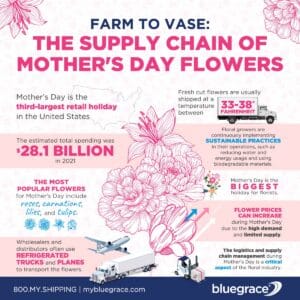
Mother’s Day is considered one of the biggest retail holidays of the year, ranking as the third-largest holiday in the United States. While finding the perfect gift can be a challenge for some, market trends consistently point toward a few favorites: cards, social outings, and flowers. Flowers remain a dominant choice for Mother’s Day, valued for their ability to brighten spaces and their historical significance as a “language” of appreciation.
However, behind every bouquet is a complex, high-stakes supply chain that operates with zero margin for error. For logistics professionals, the floral journey from farm to market is a masterclass in managing perishability, seasonal demand spikes, and the global cold chain.
The Global Journey: From Harvest to High-Altitude Transit
The journey begins at farms located in regions with optimal growing climates, including California, Colombia, Kenya, and the Netherlands. These farms operate year-round to ensure availability, but the scale of production ramps up significantly in the weeks leading up to May. Once farmers harvest and pack the stems, the race against biological decomposition begins.
Because the goal is to ship living plants, shippers want to ensure that the plant lasts for the entire duration of travel and after. To do that, businesses utilize temperature-controlled shipping services such as refrigerated trucks and planes. Freshly cut flowers are kept between 33 and 38 degrees Fahrenheit for the entire shipment. The cold temperatures help keep the plants stable and stop them from decomposing too fast.
Retailers and florists will then receive the shipment and place them in temperature-controlled displays until a customer purchases them. These businesses will usually buy flowers weeks in advance for Mother‘s Day, as it is the biggest holiday for flower sales. They will manage stock, oversee purchasing trends, and maintain inventory to ensure that they are ready for the day!
The Role of a 3PL in Seasonal Orchestration
Logistics has a lot of moving parts, both figuratively and literally. Shipping a single pallet of roses from a farm to a domestic retailer involves hundreds of touchpoints, from customs clearance to final-mile delivery. When millions of items are moved daily, it becomes a complicated balancing act of keeping everything orderly while ensuring cargo remains pristine.
A dedicated third-party logistics provider (3PL) acts as the architect of this balancing act. Rather than just moving freight, a 3PL analyzes the entire supply chain to mitigate the risks of “temperature excursions”, brief spikes in heat that can occur during tarmac transfers or at warehouse loading docks. Even ten minutes of exposure to ambient “warm zone” temperatures can drastically shorten a flower’s lifespan, even if it looks perfect upon arrival.
Strategic 3PL partners help businesses navigate these “bottlenecks” by:
- Capacity Management: Securing refrigerated (reefer) space and air cargo slots weeks in advance of the holiday rush.
- Carrier Vetting: Ensuring every carrier in the network adheres to strict pre-cooling protocols and maintains calibrated refrigeration units.
- Predictive Maintenance: Using technology to monitor the health of refrigeration equipment to prevent mid-transit failures that could lead to total inventory loss.
Technology as the Backbone of Freshness
Technology is what keeps things organized and efficient. Modern 3PLs leverage advanced Transportation Management Systems (TMS) and AI-powered tools to monitor the status and quality of shipments in real-time. This visibility is more than just knowing a truck’s GPS location; it’s about constant data flow from RFID sensors and IoT indicators that record temperature, humidity, and light levels inside the container.
AI is becoming increasingly vital for demand forecasting. By analyzing historical data and current purchasing trends, logistics providers can help retailers manage stock more effectively and better predict higher demands. This prevents the two greatest enemies of floral retail: stockouts on Mother’s Day morning and the waste of unsold, wilted inventory the following day.
Sustainability and Ethical Sourcing in Logistics
Many companies in the flower industry are now prioritizing sustainability as consumers become more conscious of where their goods come from. This involves a closer look at resource management, human labor conditions, and the carbon footprint of transport.
While air freight is often necessary for the speed required by cut flowers, it is carbon-intensive, generating significantly higher emissions than sea or road transport. To address this, 3PLs are helping shippers find a balance:
- Route Optimization: Using AI algorithms to find the most fuel-efficient delivery paths, reducing unnecessary mileage and greenhouse gas emissions.
- Modal Shifts: Where possible, shifting long-lead items to sea freight, which can emit up to 50 times less CO2 than air freight per kilogram.
- Ethical Oversight: Ensuring that the logistics chain supports Fairtrade-certified farms that protect workers’ rights and use sustainable irrigation.
The Science Behind the Sentiment
Despite the challenges and complexities of the floral supply chain, the floral industry remains an essential part of the Mother’s Day celebration. Each person’s dedication, from the farmer to the freight specialist, ensures that these flowers reach their destination on time and in perfect condition.
For the logistics professional, the goal is simple: ensure that behind the symbol of love and appreciation lies a rigorous, data-backed strategy that keeps the supply chain blooming.
 Login
Login