
Building Shipping Operations
That Attract Big-Box Retailers
Big-box retailers including Walmart, Target, Amazon, Kroger, Whole Foods, and CVS control an outsized share of consumer spending and set the toughest delivery standards in the industry. For suppliers, earning and maintaining shelf space requires more than a good product – it demands logistics operations built for compliance, speed, and visibility. This whitepaper breaks down the key challenges and what it takes to build a shipping operation that big-box retailers want.
Industries: Consumer Packaged Goods | Perishables | LTL Shippers
$5B+
in annual retailer chargebacks issued to suppliers industry-wide
98%
Walmart OTIF compliance threshold – the industry’s highest standard
30%
potential savings on freight costs through proactive logistics planning
Introduction
The retail landscape has shifted decisively over the past several years, leaving a permanent mark on how consumers shop and how suppliers must operate. Big-box retailers – Walmart, Target, Whole Foods, Amazon, Kroger, and CVS among them – now exert significant influence over their supplier networks, setting delivery and compliance standards that have only grown more demanding.
The rise of e-commerce accelerated changes that were already underway. Bulk truckload shipments that once moved on predictable schedules now compete with smaller, more frequent LTL deliveries driven by omnichannel fulfillment requirements. Buy Online, Pick Up In-Store (BOPIS) programs require retail shelves to be continuously replenished, compressing delivery windows and raising the stakes for suppliers who miss their Must Arrive By Date (MADB).
Shippers today must contend with headwinds that can undermine their supplier status: dynamic consumer demand, tightening inventory requirements from retailers, capacity constraints across modes, and an ever-expanding set of compliance rules governing how and when goods must arrive.
Getting products to big-box retailers efficiently and on-time is no longer just a logistics goal – it is a prerequisite for maintaining shelf space with the retailers that command the largest share of consumer spending.
Getting products to big-box retailers on-time is no longer just a logistics goal – it is a prerequisite for maintaining supplier status with the retailers that drive the most retail volume.
Shipping Complexities Come In All Shapes And Sizes
Shipper relationships with big-box retailers have been shaped by what the industry calls the ‘Amazon Effect’ – named after Amazon’s focus on putting customers at the center of its operations. Retailers today expect shippers to abide by optimization concepts like Just-In-Time (JIT) and On Time, In Full (OTIF), which can be challenging if shippers do not have adequate visibility into their logistics operations.
Guidelines have grown stricter over the years. Major big-box retailers like Walmart, Whole Foods, and Target set high delivery standards that require shippers to stay in compliance to continue doing business with them. As a commodity business, profit margins within retail are low, making freight and inventory optimization critical to the business model – retailers rely on increasing store throughput to realize a profit.
While the JIT technique helps big-box retailers optimize their floor inventory, it creates narrow time windows for suppliers to drop off shipments. Strict regulations result in supplier penalties and chargebacks when they fail to comply with fixed delivery windows. The complexity extends to OTIF as well – with retailers wanting products delivered on time and in full, every time. For instance, Walmart mandates a minimum 98% compliance threshold with a 3% chargeback on all shipments that miss the mark.
Major big-box retailers like Walmart, Whole Foods, and Target set high delivery standards that require shippers to stay in compliance to continue doing business with them.
Demand sensing is also critical, as suppliers must forecast product demand at the retail floor level to optimize their inventory stocking. Improved demand sensing accuracy results in efficient operations, helping improve the supplier’s net profit margin.
Retailers set high-level delivery schedules because having products in stock at all times is essential to ensure customers return to the store. Consumers can be fickle – if they do not find what they came for, they may not return. This makes retention critical for retailers, who can also upsell and cross-sell products as consumers move through the store.
Sustainability strategies have gained significant relevance across shippers. Consumer interest and government-mandated climate goals prompt retailers to hold their suppliers accountable for reducing their carbon footprint, including transport operations. Demand sensing is part of this equation – efficient inventory forecasting reduces unnecessary shipments and the emissions that come with them.
The convergence of physical and online retail through omnichannel solutions has created new inefficiencies on the backend. Rapidly evolving consumer trends make bulk or full-load shipments less predictable. Across the board, order sizes have fallen and order frequency has risen – leading to a shift down in modality, where shipments previously moving truckload may now move as partial or LTL.
Big Box Retailers’ Search For Inventory
The retail market is split between physical stores and e-commerce. Traditional big-box retailers like Walmart are expanding their online presence, while e-commerce leaders like Amazon continue investing in physical floor space through Whole Foods and Amazon Go stores. The rivalry between Amazon and Walmart has expanded well beyond the United States, with both companies competing for control in global retail markets.
Within the U.S., Walmart remains the dominant force in physical retail, accounting for approximately 11% of total U.S. retail sales. Amazon holds roughly 10% of total retail across all channels – and leads U.S. e-commerce with more than 40% market share. With consumer spending continuing to shift toward digital channels, that gap will be contested.
Omnichannel solutions are proving to level the playing field – particularly for big-box retailers with a significant physical presence. Buy Online, Pick Up In-Store (BOPIS) has become a major channel, allowing customers to purchase online and pick up at a nearby location within hours. With a physical store within 10 miles of 90% of American households, Walmart can fulfill BOPIS orders in ways that pure e-commerce platforms cannot easily match.
With a physical store within 10 miles of 90% of American households, Walmart can promise customers BOPIS options that let them pick up their orders within a few hours.
BOPIS requires big-box retailers to ensure products are always in stock across their store inventories. With e-commerce fueling physical retail throughput, suppliers must be prepared to deliver smaller order sizes with a wider variety of products across more frequent time intervals. Delivery windows will continue to tighten as retailers demand better adherence to delivery schedules.
Walmart OTIF Compliance Requirements
OTIF
Walmart’s On Time, In Full program applies to all orders using a Must Arrive By Date (MADB). Compliance is measured at the case level on every shipment. – Walmart Supplier Center
98%
On Time and In Full compliance threshold – one of the strictest standards in retail. Suppliers must meet this benchmark to avoid deductions. – Walmart OTIF Program
3%
Chargeback on all shipments that miss the 98% OTIF threshold, assessed as a percentage of the cost of goods on the non-compliant cases. – Walmart Vendor Compliance
Many major retailers use MADB and OTIF metrics to evaluate whether your company is effectively delivering goods that meet these specified standards:
Options like BOPIS force big-box retailers to keep products consistently in stock. Retailers issuing stricter delivery requirements are a direct response to consumer behavior – customers who do not find products on shelves often will not return. The delivery time windows will continue to get smaller as retailers demand tighter schedule adherence across their entire supplier base.
Non-compliance has real financial consequences beyond Walmart. Industry data shows that retailers collectively issue more than $5 billion in chargebacks to suppliers every year. For individual suppliers, those deductions can represent 2 to 10% of annual gross revenue – a significant margin impact, especially given how thin retail margins already are.
Future-Proofing Supplier Operations From Stringent Retailer Demands
For shippers looking to stay in good supplier standing with big-box retailers, optimizing sourcing operations and tracking product provenance is only the beginning. Putting together a plan and schedule to ensure seamless logistics and freight delivery accuracy is the foundation of the supplier-retailer relationship.
Suppliers must dynamically balance their portfolio of dedicated freight contracts – signed for fixed time intervals – against the spot market, based on shipment volume and shipping frequency. Optimizing shipment movements can eliminate excess capacity needs. Freight optimization requires managing operations upstream and being an intelligent shipper who controls and monitors order sizes, rather than continuously reacting to customers’ evolving needs.
To optimize freight operations, suppliers need visibility into workflows – possible only when processes are digitalized and data streams are structured to create actionable insights. Visibility into consumer demand enables shippers to consolidate freight and choose the right mode to reach the right retailer at the right time.
However, companies today often struggle with having clean access to accurate data, even when they store substantial amounts of relevant information. The issue lies in how data is stored – across different systems, files, and locations. While sales and cost insights are relatively accessible, transportation data is harder to act on, as in-sourced suppliers seldom capture it in a way that drives data-driven decisions.
If companies could identify last-minute LTL and full truckload needs earlier, they could reduce shipping costs by up to 30% through better mode selection, load consolidation, and carrier planning.
Transportation affects customer service differently than it affects revenue, operations, and sales. For a supplier to stay on top of its logistics operations, it is crucial to understand how transportation impacts every stakeholder within the organization – what is expected of a transportation solution, and what type of intelligence each business unit needs. Transportation solutions must be built through bottom-up integration, improving operations across every individual business unit.
Managing transport provider performance is critical. Shippers supplying big-box retailers have complicated hauling schedules that require process automation to execute reliably. Depending on manual data entry and phone or email communication leads to errors that are disastrous to a supplier’s business. Process automation removes the need to manually monitor purchase orders and integrates information – including ASNs, labels, and barcodes – across systems.
Outsourcing or managed logistics solutions can be of great help, enabling data-driven decisions for automating the selection and execution of transportation. This saves working capital and allows companies to direct resources toward more human-intensive operations.
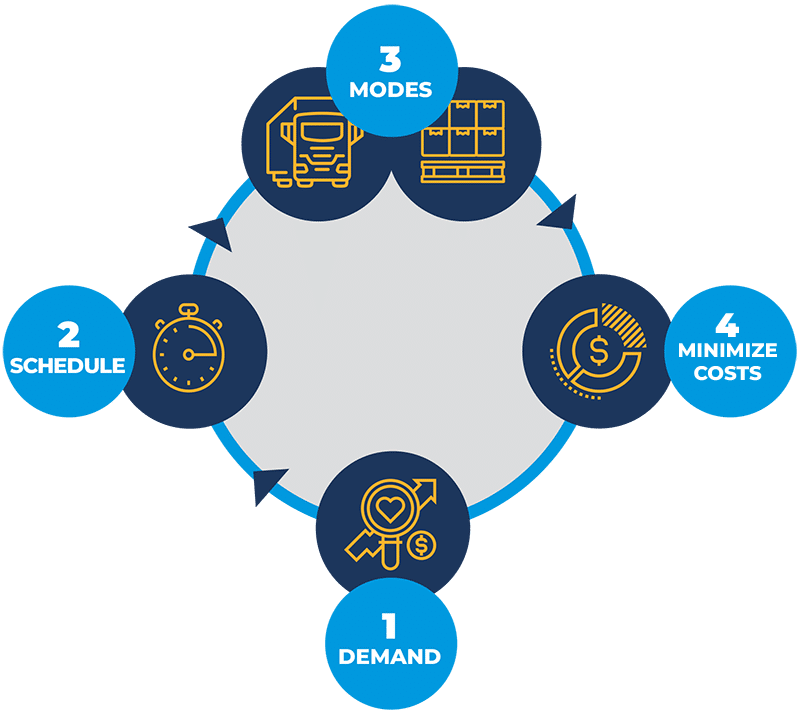
Three Core Challenges for CPG Suppliers Serving Big-Box Retailers
1
Consumer Demand
Forecasting how much product will sell, and when – at the retail floor level.
2
Delivery Schedule
Meeting strict retailer delivery windows without excess capacity waste.
3
Mode and Cost
Selecting the right transport mode to minimize cost per unit shipped.
Industry Specific Shipper Challenges
Consumer Packaged Goods (CPG) Shipper Challenges
Being a good supplier to a big-box retailer comes down to managing orders correctly and understanding which mode works best for a specific shipment. CPG companies are faced with three major challenges when catering to big-box retailers: understanding consumer demand, meeting their given delivery schedule, and optimizing transport modes and capacity to minimize cost per unit shipped.
Shipments are often moved in full truckload even when cargo does not occupy the entire trailer. This is usually because suppliers are less experienced with LTL or partial modes – where the propensity for delays is greater – despite those modes being significantly cheaper options. Understanding when and how to use each mode is a core competency for any supplier serving retailers with strict OTIF requirements.
53′ Dry Van – Max Dimensions
Maximum Loading Weight:44,000 lbs.
Standard Pallets Inside:26
Door Opening:102″W x 110″H
Inside Dimensions:52’–6 1/4″ x 102″ x 110″
Less Than Truckload (LTL) Shipper Challenges
The biggest challenge in LTL shipping is reaching an accurate estimated time of arrival (ETA). For suppliers pushing shipments via LTL, the primary concern is limited control over freight movement compared to full truckload. If suppliers can forecast demand better, they can afford to source earlier and push shipments via LTL or partial, saving a significant portion of freight costs.
Companies like Walmart have introduced the Supplier Quality Excellence Program (SQEP), designed to optimize logistics by reducing handling and transport costs. Using LTL shipping under stringent retailer regulations requires complete automation of repetitive tasks – including shipment planning, carrier selection, and shipment execution.
Labeling and packaging requirements cannot be automated, but when other processes are handled through technology, carriers can concentrate on those manual tasks. They can ensure purchase orders are accurate and the right products are on the order list – all of which registers directly on the final OTIF score.
Perishable Shipper Challenges
Perishable suppliers face two primary challenges: shorter delivery windows and significantly lower available capacity in the refrigerated truck market. Temperature control is a prerequisite for transporting and storing perishables, which means their supply chains have far more moving parts than a standard CPG supply chain. Every node in the value chain requires temperature-controlled spaces to accommodate the shipment.
Labor shortages remain a long-term challenge in the perishable segment, contributing to longer dwell times and taking more capacity out of the marketplace. Perishable suppliers also contend with demand volatility driven by seasonal shifts and changes in consumption patterns. Combined with shorter lead times from big-box retailers, perishable shipping is among the most complex logistics environments in the industry.
These complexities make process automation especially important for perishable suppliers. Technology can provide visibility over freight tenders and rejections – critical for a segment where temperature-controlled freight gets rejected based on demand for capacity, making it essential for suppliers to know what to expect in the market before committing to a shipment plan.
Solutions for Big-Box Supplier Shippers
OTIF Compliance and Retailer Standards
Meeting the delivery standards of big-box retailers requires a proactive, system-driven approach to compliance:
Three key solutions:
Transportation Management Systems (TMS)
Implement a TMS that provides real-time visibility into shipment status, automates MADB tracking, and flags shipments at risk of missing their delivery window before they arrive late.
Work with a managed logistics partner who has retailer-specific compliance expertise built into their carrier selection and routing processes, reducing OTIF failures at the source.
Advanced Ship Notice (ASN) Automation
Automate ASN generation and submission to eliminate manual entry errors that trigger retailer chargebacks on labeling and paperwork violations.
Integrate your ERP or order management system with your carrier’s systems to ensure ASNs, barcodes, and purchase order data are accurate and transmitted on time.
Chargeback Audit and Recovery
Audit all retailer deductions regularly. Industry data shows that 10–20% of chargeback deductions are invalid but go unchallenged – recovering those dollars requires a systematic review process.
Mode Optimization and Freight Planning
Selecting the right mode and planning shipments earlier is one of the highest-leverage opportunities for cost reduction.
Three key solutions:
Demand Forecasting and Load Planning
Use demand forecasting tools to identify shipment needs earlier in the planning cycle. Moving freight via LTL or partial instead of full truckload – when volumes allow – can reduce freight spend by up to 30%.
Partner with a 3PL that has load optimization software. By inputting past shipment data, a 3PL can build optimized load plans that account for holidays, seasonal demand spikes, and retailer-specific delivery requirements.
Multi-Mode Carrier Strategy
Build a carrier base that spans truckload, LTL, and partial modes. Relying on a single mode creates vulnerability – especially when capacity tightens and full truckload rates spike.
Implement drop trailer solutions where volumes are consistent, giving suppliers flexibility to build trailer pools and schedule shipments without being constrained by live driver availability.
Process Automation for Repetitive Tasks
Automate carrier selection, shipment execution, and PO monitoring. Removing manual steps from these workflows reduces errors and frees operations staff to focus on tasks that require judgment – such as labeling, packaging compliance, and exception management.
Perishable and Temperature-Controlled Freight
Perishable suppliers need tools and partners equipped for the complexity of temperature-controlled logistics.
Three key solutions:
Refrigerated Capacity Access
Partner with a 3PL that has pre-qualified reefer carrier relationships and up-to-date capacity availability data. Perishable freight gets rejected more often than dry freight – having backup carrier options is not optional.
Monitor freight tender rejection rates in your primary lanes. A managed logistics partner can provide this visibility and help you plan around high-rejection periods driven by seasonal demand for refrigerated capacity.
Visibility Over the Full Cold Chain
Implement temperature monitoring and real-time tracking across every node in your cold chain. Retailers will hold suppliers accountable for temperature excursions – documentation of in-transit conditions is your first line of defense.
Seasonal Demand Planning
Develop retailer-specific routing guides for peak seasons and coordinate with your 3PL to lock in capacity commitments ahead of demand spikes. Perishable capacity is far more constrained than dry during summer and holiday periods.
Conclusion
For suppliers looking to stand out from the crowd and maintain preferred vendor status with big-box retailers, real-time visibility into freight operations is no longer optional. With consumer expectations and consumption patterns evolving faster than ever, shippers need to inject flexibility into their operations to stay future-proofed against volatility.
Digitalization, followed by process automation, helps companies reduce inefficiencies and run streamlined operations. Eliminating siloed data across the organization – integrating transportation, order, and demand data onto a single accessible platform – enables shippers to create actionable insights that support profitability rather than simply tracking costs after the fact.
Ultimately, a supplier’s success lies in how efficient their operations are, how fast they can get to market, and the quality of the relationship they maintain with big-box retailers. A tech-forward approach combined with a consistent logistics strategy enables suppliers to sense demand and run resilient operations – even in a supply chain environment as demanding as today’s.
BlueGrace Logistics helps suppliers across CPG, perishables, and LTL build the compliance-ready, data-driven freight operations that big-box retailers expect. Whether the goal is reducing OTIF failures, optimizing freight mode selection, or building a carrier network capable of meeting retailer delivery windows, BlueGrace provides the expertise and technology to make it happen.
© 2026 BlueGrace Logistics I.P. LLC. All Rights Reserved.
 Login
Login